Give your agent
spatial superpowers.
Frontier models guess at space — what's where, will it fit, will it tip — and get it wrong. Universtato gives your agent a deterministic 3D world it can compute over, remember, and share — one source of spatial truth for every agent and human in the loop. One pip install or one MCP connector.
from universtato import World

w = World()
w.place("box", name="crate", x=0, z=0, width=1, height=1, depth=1)
w.place("box", name="lid", x=0.6, y=1, z=0, width=2, height=0.2, depth=1)

w.stability()   # → "lid overhangs crate by 0.6 m — tips east"
A cheap model + Universtato beats Opus at spatial reasoning
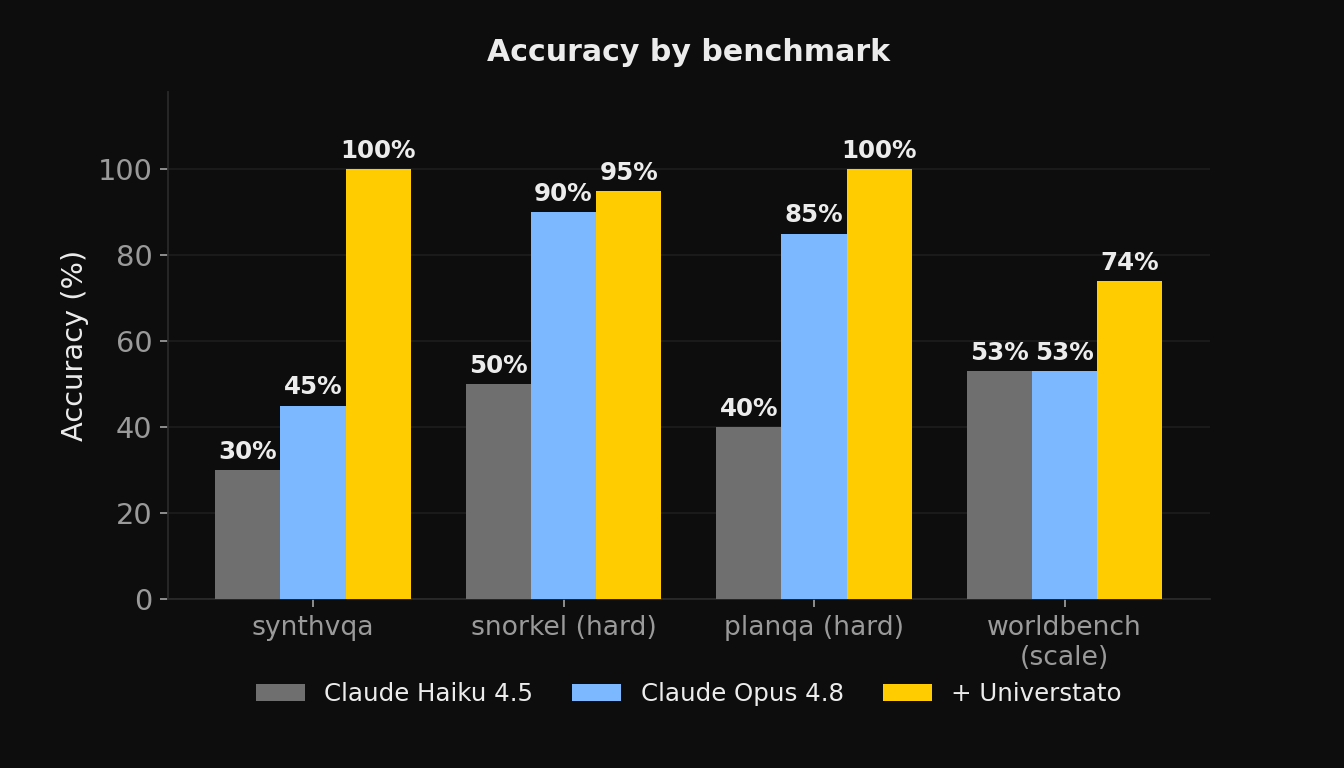
Spatial questions are computation, not guesswork — and frontier models guess. Hand the geometry to the engine and it returns the exact answer, so even a small, cheap model (Haiku) matches or beats the strongest frontier model (Opus) on every hard spatial benchmark we tested. That's the value: correctness you can trust for anything physical — from a model you can actually afford to run.
On WorldBench, deterministic physics beats a 7B video model
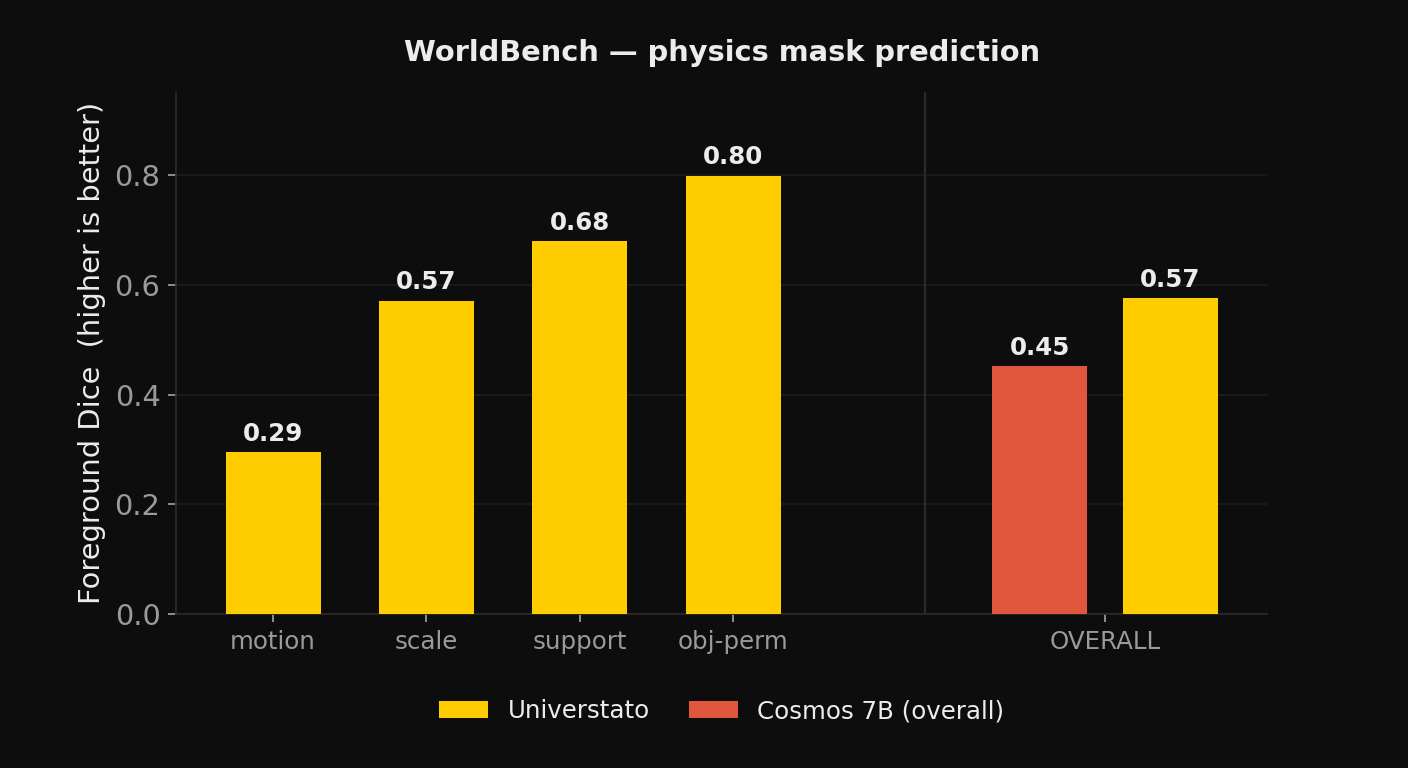
WorldBench tests physical prediction from video. Generative world-models (Cosmos) hallucinate and drift; Universtato instead lifts each object into 3D and predicts what happens next from real physics — no video generation. It wins on the benchmark's own metric, and lifts a small model past Opus on the video questions.
Free to build. Pay only for the heavy lifting.
Pricing is usage-based and transparent. You buy credits (1 credit = $0.01) and spend them per call — no seats, no minimums. Scene editing and the core deterministic queries are free even with a key; you only meter the heavy ops. Every new account starts with 100 free credits.
Starter $10
1,000 credits. Kick the tires — physics, stability, and a taste of perception.
Growth $80
10,000 credits — including 2,000 bonus. For agents in active development.
Scale $600
100,000 credits — including 40,000 bonus. Production volume, best per-credit rate.
Bonus credits cover the compute ops; the pass-through ops (perception, NL parse) draw on paid credits, so the bulk discount never erodes our cost. Running a team? Switch to monthly metered billing with a shared credit pool across seats.
And the metered ops still cost less than a frontier model
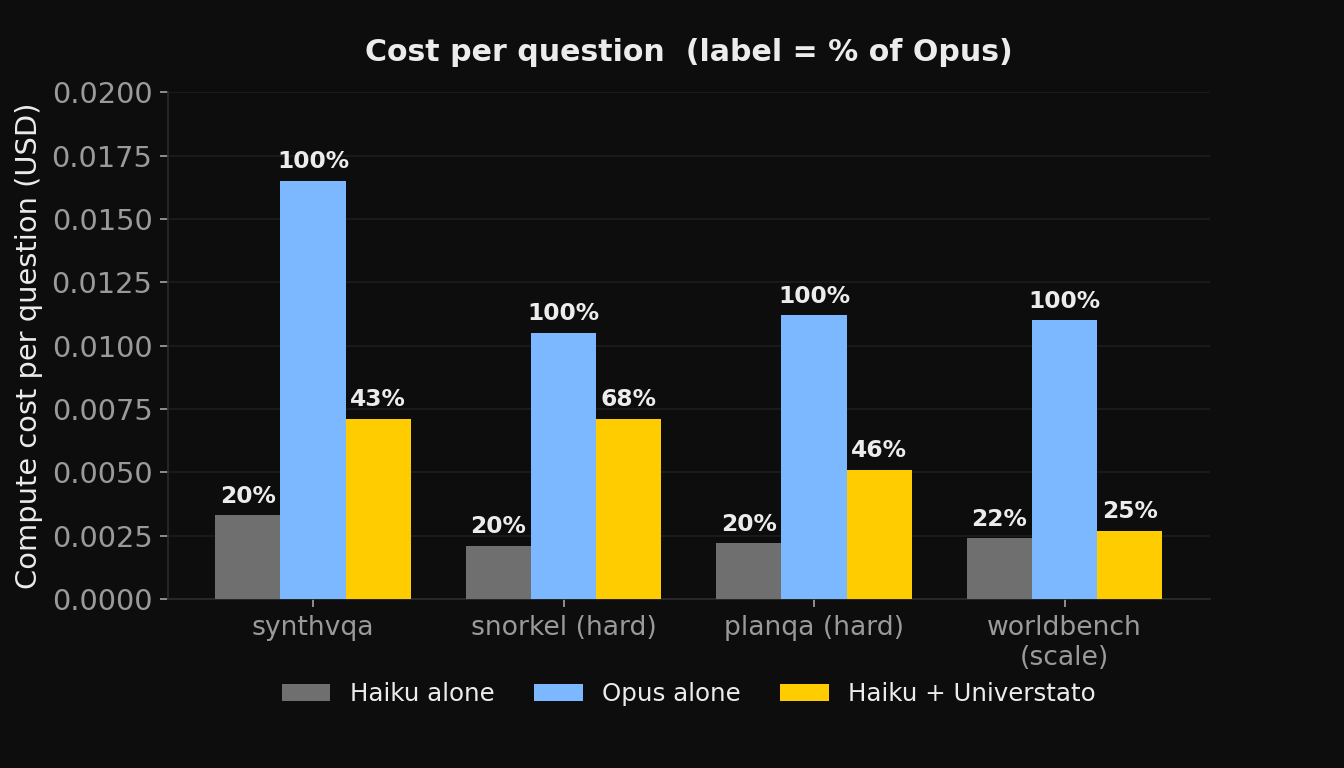
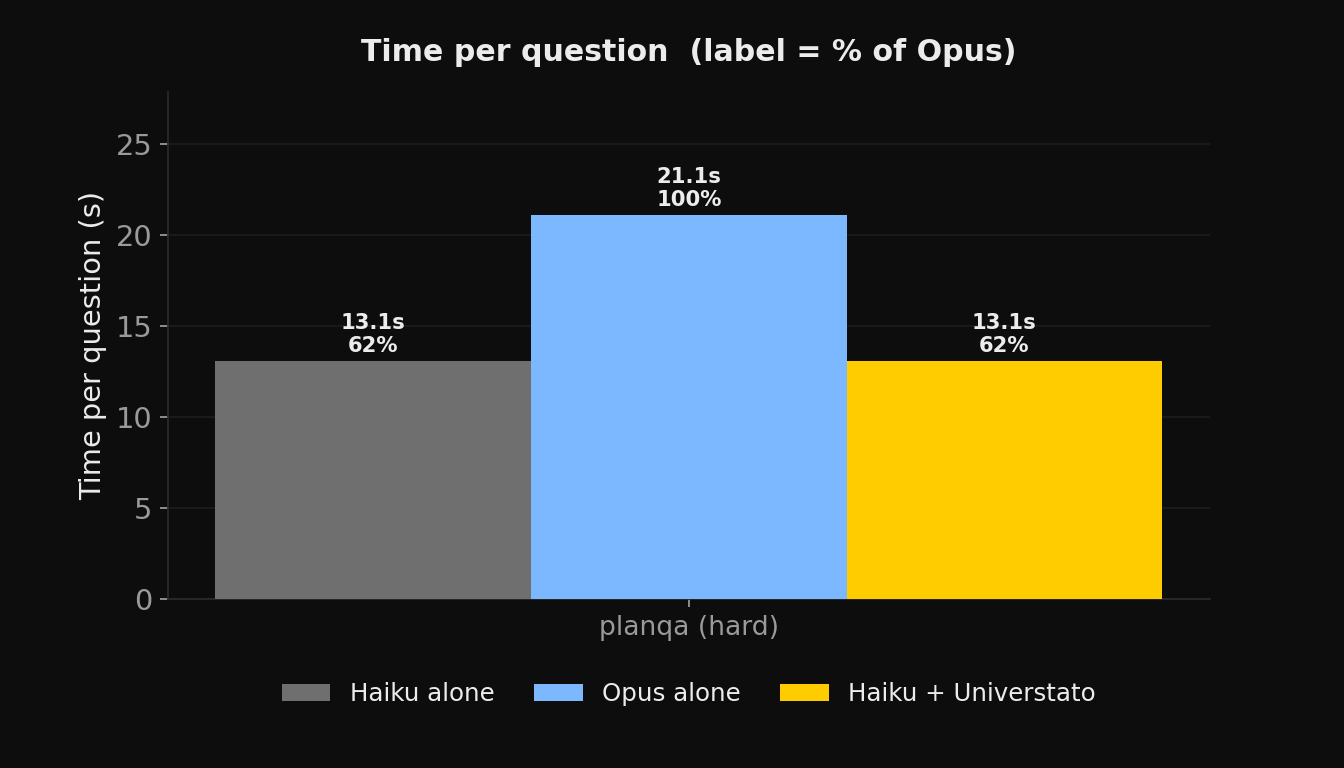
Because the engine does the geometry in a single call instead of the model grinding through a long chain-of-thought, Haiku + Universtato is more accurate than Opus and runs in a fraction of the cost and time.
Not a calculator — a world your agent lives in
Spatial intelligence isn't one trick. Universtato is a persistent, shared world: your agent works out the geometry, trusts that it stays put, and sees the same truth everyone else does.
Compute
Relations, visibility, paths, physics, stability, scale — the exact answer computed from the scene, not guessed. Deterministic: same world in, same answer out.
Remember
The world is persistent. Put something down and it stays where you put it — your agent recalls an object's last-known position even when it's out of view, across steps and sessions. Memory you can query, not a context window that forgets.
Share
One world, many minds. Multiple agents and a human can read and edit the same ground truth at once and watch it update live — so the whole team reasons over one reality instead of drifting copies.
Three ways to plug it in
Same engine, same 11 capabilities — on a local scene or connected to a shared, persistent world. Adoption is a pip install or a single connector.
Python SDK
pip install universtatoWorld() → call predict, relations, stability, navigate. Run it on a local scene or connect to a shared world and read/edit the same live state.
MCP server
universtato[mcp]
One connector and your LLM agent gets spatial tools it calls mid-task — building, computing, and remembering in a shared world it can hand off via a live viewer link.
gRPC runtime
The shared world itself: persistent, live, multi-client — agents and humans on one ground truth, with a real-time 3D viewer. The deployment backbone.
Eleven spatial operators, one call each
Where a shared spatial truth changes the game
Embodied & robotics agents
Turn RGB-D into a scene, then ask: is it reachable, will the grasp topple the stack, what's the collision-free path? The agent remembers where each object is across the whole task.
Simulation & digital twins
Run physics rollouts, stability checks, and what-ifs over a USD/BIM scene — a fleet of agents planning against one consistent twin instead of guessing.
Multi-agent collaboration
Several agents building or operating one warehouse, site, or layout read and edit the same live world — no drifting copies, no re-describing the scene to each other.
AR & spatial computing
Query the scene mesh from the headset: what's where, can the user see it, does it fit the space — grounded in real geometry, answered deterministically.
Game & NPC brains
NPCs that actually reason about the level — visibility, navigation, what's on what — with exact, reproducible answers instead of hallucinated layouts.
Spatial memory for chat agents
Give an LLM a persistent world it places things in and recalls later — "it's where you left it" — so a long task or session keeps one coherent picture of space.
A source of truth, not a better guess
It computes
Same scene in, same exact answer out — every time. No sampling, no hallucination. The kind of answer you can put in front of a robot or a real layout.
Fast & drop-in
Answers in milliseconds, and you adopt it in one call — a pip install or a single MCP connector. Nothing to provision, no simulator to stand up.
Honest about limits
Strong when you have geometry — sensors, sim, USD, AR mesh. Raw-photo perception is optional and labeled partial-fidelity, so you can trust the rest.
Stop letting your agent guess about space.
Build for free — scene editing and core queries cost nothing. Pay only for the heavy lifting: physics, stability, simulation, perception, and natural-language parsing.